
Surgical Spine Care
Comprehensive surgical spine evaluation and treatment for cervical, thorracic, and lumbar spine conditions causing nerve compression,spinal instability, neurologic symptoms, and functional limitations.
As a board-certified orthopedic spine surgeon with fellowship training at the San Francisco Spine Institute and prior experience as chief of spinal surgery at UTMB, Dr. Garges evaluates both common and complex spine conditions involving the cervical, thoracic, and lumbar spine.
His approach focuses on careful surgical decision-making based on symptoms, neurologic examination, imaging findings, prior treatment response, and overall functional impact.
Symptoms That May Require Surgical Spine Evaluation
Patients often seek surgical spine evaluation after symptoms significantly causing mobility, work activities, sleep, or quality of life.
Symptoms vary depending on the location of spinal involvement and the severity of nerve or spinal cord compression.
Neck and Arm Symptoms
Cervical spine conditions may cause:
- Persistent neck pain
- Arm pain radiating from the neck
- Shoulder blade pain
- Numbness or tingling in the hands or fingers
- Weakness in the arms or hands
- Difficulty gripping or holding objects
- Loss of hand coordination
- Balance problems or gait instability
Progressive hand weakness, dropping objects, or balance difficulty may indicate spinal cord compression requiring prompt evaluation.
Lower Back and Leg Symptoms
Lumbar spine conditions commonly cause:
- Persistent lower back pain
- Sciatica
- Leg numbness or tingling
- Weakness in the legs or feet
- Difficulty standing or walking
- Pain worsening while standing
- Reduced walking tolerance
- Symptoms interfering with sleep or work
Some patients experience neurogenic claudication caused by spinal stenosis, where walking becomes progressively limited until sitting or leaning forward relieves symptoms.
Functional Decline
One of the most important aspects of surgical evaluation is understanding how symptoms affect function.
Patients may reach the point where they:
- Cannot walk normal distances
- Struggle to work comfortably
- Cannot sleep due to pain
- Avoid daily activities because of symptoms
- Experience progressive mobility decline
- Have difficulty performing normal household tasks
Functional limitations often play a major role in determining whether surgical treatment should be considered.
Spine Conditions Commonly Evaluated for Surgical Care
Dr. Garges evaluates a wide range of cervical, thoracic, and lumbar spine conditions that may contribute to pain, neurologic symptoms, spinal instability, or functional impairment.
Herniated Discs
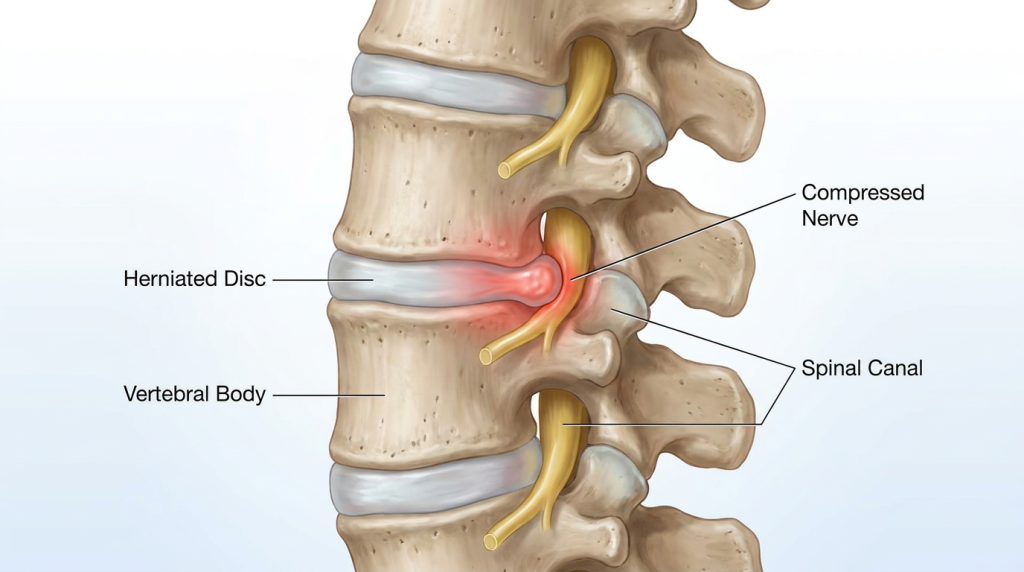 A herniated disc occurs when disc material extends beyond its normal boundary and compresses nearby nerves.
Cervical disc herniation may cause:
- Neck pain
- Radiating arm pain
- Hand numbness
- Arm weakness
Lumbar disc herniation commonly causes:
- Sciatica
- Leg pain
- Foot numbness
- Weakness in the leg or foot
Many herniated discs improve with conservative treatment. Surgical evaluation becomes more important when symptoms persist despite therapy, medications, injections, or activity modification.
Spinal Stenosis
Spinal stenosis involves narrowing of the spinal canal or nerve passageways.
This narrowing may result from:
- Bone spurs
- Degenerative arthritis
- Disc bulging
- Ligament thickening
- Degenerative instability
Lumbar spinal stenosis commonly causes:
- Leg pain while walking
- Standing intolerance
- Sciatica
- Walking limitations
Cervical spinal stenosis may contribute to:
- Arm weakness
- Hand numbness
- Loss of coordination
- Balance problems
- Spinal cord compression symptoms
Some patients improve with conservative care, while others develop progressive neurologic symptoms requiring surgical evaluation.
How Dr. Garges Evaluates Surgical Candidacy
Surgical spine evaluation involves much more than reviewing an MRI report.
Dr. Garges performs comprehensive assessment to determine whether structural pathology identified on imaging is truly responsible for the patient’s symptoms and whether surgery is likely to improve function.
| Evaluation Component | Purpose |
|---|---|
| Symptom Review | Identifies pain patterns, numbness, weakness, progression, and functional limitations |
| Neurologic Examination | Evaluates strength, sensation, reflexes, coordination, and spinal cord function |
| Imaging Correlation | Determines whether MRI or CT findings match symptoms and examination findings |
| Treatment History | Reviews physical therapy, injections, medications, and prior procedures |
| Functional Assessment | Evaluates mobility decline, work limitations, sleep disruption, and activity restrictions |
Imaging findings alone do not determine treatment. Many MRI abnormalities represent age-related changes rather than clinically significant pathology.
Dr. Garges carefully determines:
- Whether symptoms match imaging findings
- Whether nerve compression is clinically significant
- Whether neurologic deficits are progressing
- Whether surgery is likely to improve function
- Whether conservative treatment remains appropriate
Patients should bring prior imaging studies, radiology reports, operative reports, and records of prior treatment whenever possible.
Types of Surgical Spine Procedures
When surgery becomes appropriate, procedure selection depends on the diagnosis, anatomy, spinal stability, location of pathology, and overall treatment goals.
Spinal Decompression Procedures
Decompression surgery removes pressure from spinal nerves or the spinal cord.
Common decompression procedures include:
- Laminectomy
- Laminotomy
- Microdiscectomy
- Foraminotomy
These procedures may be used to treat:
- Spinal stenosis
- Herniated discs
- Nerve root compression
- Foraminal narrowing
The goal is to relieve clinically significant nerve compression contributing to pain, numbness, weakness, walking limitations, or limitations in arm and hand function.
Spinal Fusion Procedures
Spinal fusion stabilizes segments of the spine when instability contributes to symptoms or when decompression procedures may create instability.
Fusion may be considered for:
- Spondylolisthesis
- Degenerative instability
- Spinal deformity
- Recurrent instability after prior surgery
- Multi-level degeneration
Not all spine surgery requires fusion. Surgical planning is individualized based on each patient’s anatomy and diagnosis.
Minimally Invasive Techniques
Some patients may be candidates for minimally invasive surgical techniques using smaller incisions and targeted surgical access.
However, minimally invasive surgery is not appropriate for every patient or condition.
Dr. Garges selects the surgical approach based on what best addresses the clinical problem rather than using a single technique for every patient.
When Spine Surgery May Be Considered
Most patients begin with conservative treatment before surgery is considered.
Non-surgical treatment may include:
- Physical therapy
- Medication management
- Epidural steroid injections
- Activity modification
- Posture and ergonomic changes
- Exercise and rehabilitation programs
Surgical evaluation may become appropriate when:
- Symptoms persist despite conservative care
- Neurologic symptoms progressively worsen
- Walking becomes severely limited
- Weakness develops in the hands, arms, legs, or feet
- Spinal cord compression affects coordination or balance
- Quality of life becomes significantly impaired
Progressive weakness, worsening neurologic deficits, or spinal cord compression symptoms require prompt evaluation.
Dr. Garges carefully evaluates whether surgery is likely to improve the patient’s symptoms, neurologic function, and daily activity level before making surgical recommendations.
Imaging and Surgical Planning
Advanced imaging plays an important role in spine surgery evaluation and planning.
MRI Evaluation
MRI is commonly used to evaluate:
- Disc herniation
- Spinal stenosis
- Nerve compression
- Spinal cord compression
- Soft tissue abnormalities
MRI helps identify clinically significant pathology affecting neural structures.
CT and X-Ray Evaluation
CT imaging provides detailed evaluation of bone anatomy and degenerative changes.
X-rays help evaluate:
- Spinal alignment
- Instability
- Scoliosis
- Spondylolisthesis
- Motion between vertebrae
Flexion-extension X-rays may be used when instability is suspected.
These studies help determine whether decompression alone or decompression combined with stabilization may be appropriate.
Why Patients Choose Dr. Garges for Surgical Spine Evaluation
Patients frequently seek evaluation after experiencing persistent symptoms, mobility decline, or uncertainty regarding whether surgery is truly necessary.
Dr. Garges focuses on careful surgical decision-making rather than recommending surgery based solely on imaging findings.
Patients often choose Dr. Garges because he:
- Personally reviews imaging studies in detail
- Explains findings clearly and directly
- Evaluates both surgical and non-surgical options
- Has extensive experience with complex spine conditions
- Correlates symptoms carefully with imaging findings
- Takes time to answer questions thoroughly
Patients are not automatically directed toward surgery. Recommendations are individualized based on diagnosis, neurologic findings, functional limitations, imaging correlation, and treatment goals.
Surgical Spine Care in Webster, TX
Additional spine services include: